Postmodernism
began as a philosophical movement amid the aftermath of World War 2 in Europe
and stems from a general cynicism with thirties-era modernism. In short, postmodernism
is largely about questioning modernist notions of narrative, plot and
characterization. Many postmodern authors
wanted their readers to be more aware of how storytelling works and interact
and question it so that they become active rather than passive audiences.

Examples of Postmodernism in Video Games
The
world we live in today can be considered postmodern; we can see this reflected
in the works that exhibit aspects of postmodernism. Video games, unlike other
forms of Media, are still young and only started around the 60’s - 70’s. In a
way, video games developed alongside the postmodernist movement.
Examples
of postmodernist elements in video games include:
Subjectivity
Subjectivity
is about how each person sees something and thus decides how to act towards it.
Whenever someone reads a book or watches a film, that person will have a
subjective view about the work and the themes within it. In the media of video
games, especially Role-Playing Games (RPGs), people (the player) can express
their views in-game. These moments offer take the form of scripted choices, though
these types of choices can vary depending on what type of “mortality system” a game
has.
One
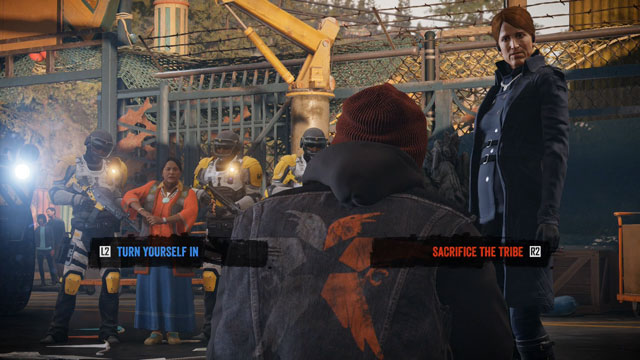
type of mortality system is the “karma meter”,
such as the one featured in the Infamous
series, where it is the game’s developer who decides what choices are “good”,
“evil” or “neutral”. However, this can lead to player feeling restricted, since
whether a choice is good, evil or neutral is entirely up to personal
interpretation. An example of a scenario when a karma system falls apart; the
player confronts a corrupt King who is responsible for the deaths of hundreds
of people, the player is given the option of either killing or sparing the
King, who is unarmed and unable to defend himself. If the person playing the
game believes that killing the King is what he deserves but is given evil
points added to their karma meter, then the player can feel better annoyed.
A
different and more fluid type of mortality system is “companion approval”,
mostly prominently featured in the Dragon
Age series. Instead of a system when there is a universally “good” choice,
each action is received differently by different characters in the game. In the
case of applying this system “The Corrupt King” scenario: if player, who is
joined by three non-player characters called Arthur, Emily and Drake, decides
to kill the corrupt King, Arthur will disapprove the choice, Emily will approve
while Drake will be indifferent. The results come off as more nature than the
karma meter method.

Shallowness
In
postmodern philosophy, there is only ever a single authentic moment which is
when that moment happened, any recounts of that moment would merely be
representations of that moment except the original moment itself. For example, René
Magritte’s The Treachery of Images is
a painting of a pipe with the words "Ceci n'est pas une pipe." (which
is French for "This is not a pipe.") underneath it.
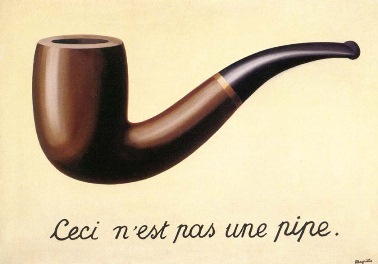
“This is not a pipe”, it’s a
photonic projection of a digital recording of a scan of a photograph of a
painted representation of Magritte's perception of a pipe.
When
broken down, video games are complex illusions made from coding which acts as a
foundation to add assets like models, textures, audio and many more elements
that are needed to create a game.
However, just because video games
and all other works, be they fictional or factual, aren't truly “authentic” and
are merely representations of moments, for example; halfway through a game, a
character called Bart dies in scripted cutscene but Bart doesn't really die, it
was just a virtual character model that was animated in such a way as to mimic
dying. Even so the person playing the game can have an emotional reaction to
the death scene, this applies to all forms of representations, what we see may
not be real but our feelings towards it are real.
Intertextuality
Intertextuality
is about mixing different texts and genres together, this can result in “a
story within a story” an example of this kind of work would be Cloud Atlas. In this case, all the
stories are connected through themes, with each story exploring those themes in
different ways.
When
genres are mixed together, it often results in a work that does not fit into
any established genre. The work can have aspects from defined genres like
horror and still not be a work of horror. An example of a video game that
defies genre would be Katamari Damacy,
which involves rolling a large, sticky ball over the environment and growing in
size as larger and larger objects attach themselves to the ball.

Non-linear
Narrative
The
way in which experience narrative in video games not only depends on how the
developer structures the narrative in the way they want to present it to the
player, but what kind of gameplay the game has, for example; open-world games,
such as Fallout 3, allow the player to abandon the main story in favour of
exploring the world. Other games let the player decide what order to do certain
story missions; this is what is known as non-linear gameplay.

An interesting example of a game
that has a non-linear narrative but linear gameplay, is Beyond: Two Souls. The game narrative jumps to different points in
the protagonist’s life, however the gameplay is quite linear, players are often
restricted to limited area when give control of the character and almost
impossible to die or fail to progress. The game offer the player the ability to
make choices, however, due the game’s non-linear
narrative player will already know when the protagonist will inevitable end up
regardless of their choices.

Knowingness
Knowingness
is when a creator purposefully draws attention aspects of the work. Knowingness
can take many different forms; two examples of these would be Parody and
Deconstruction.
A
parody is a work created to imitate and usually make fun of an original work,
its subject or even author by means of satiric or ironic imitation. An example
of a parody game would be Duty Calls which
mocks elements in First-Person Shooter games primarily the Call of Duty series:
A deconstruction
takes apart a work so as to better understand its meaning and relevance to us
in Real Life. This often means pursuing aspects of work’s inherent
contradictions and the difference between how they appears in this one work and
how they compare to other relevant works or ideas both in fiction and Real
Life. An example of deconstructive game would be Undertale, the game is a Deconstruction of RPGs, both on a
superficial level from satirical flavour text to the in-depth plot.

Minimalism
Minimalism
is having things as bare-bones as possible, applying this to a game would having
few control options and a simplistic art style. An example of a minimalist game
would Journey which only has four
controls (move character, move camera, interact and pause), there is almost no
spoken (the only spoken works are said in a song during the credits but none of it is in English) or written dialogue (the only
words that appear are at the title screen, the start and the end of the game).
The game’s story is expressed through imagery and music.

Copyright in a Postmodern World
NOTE: Copyright laws vary from
country to country.
Copyright
is a legal right that grants the creator of an original work the exclusive
rights for its use and distribution. The purpose of copyright is to protect
creators who use their works to make a living selling their work, especially if
they’re an independent artist.
Even if a work is copyrighted,
elements from that work can still used by other people if they are given
permission from the original creator or if their being used under fair use i.e. educational research, criticism
or parody. An example of a fair use parody would be Weird AI Yankovic’s song The Saga Begins which is a parody song
based on Star Wars.
Another
form of copyright is the Creative Common
License which person copy and alter a work as long as the original creator is
credited. A video explaining how Creative Commons works can be found here.
Problems with Copyright
However
copyright is not without problems, when someone asked for permission regarding
copyrighted material, creators (often big companies) will ask for payment before
giving permission. Some creators may withhold their permission as they may not want
their work featured in someone else’s, this can sometimes become a form of
censorship in certain cases.
An important example of the flaws
with copyright, in 2013 YouTube launched an automatic content IP system that
resulted in thousands, mainly video game related, being flag for copyright
infringement ever though there where video that abided by fair use:
False
Copyright Claims
As
mentioned above, copyright can be used as a form of censorship; for example,
creators can make copyright claims on YouTube videos that they believe violates
fair use of their work, sometimes these claims are justified but on other
occasions they are often used to hide criticism of their work:
However,
in 2015, YouTube started its “Fair Use Protection” program to helped users who
have received undeserved copyright claims:

No comments:
Post a Comment